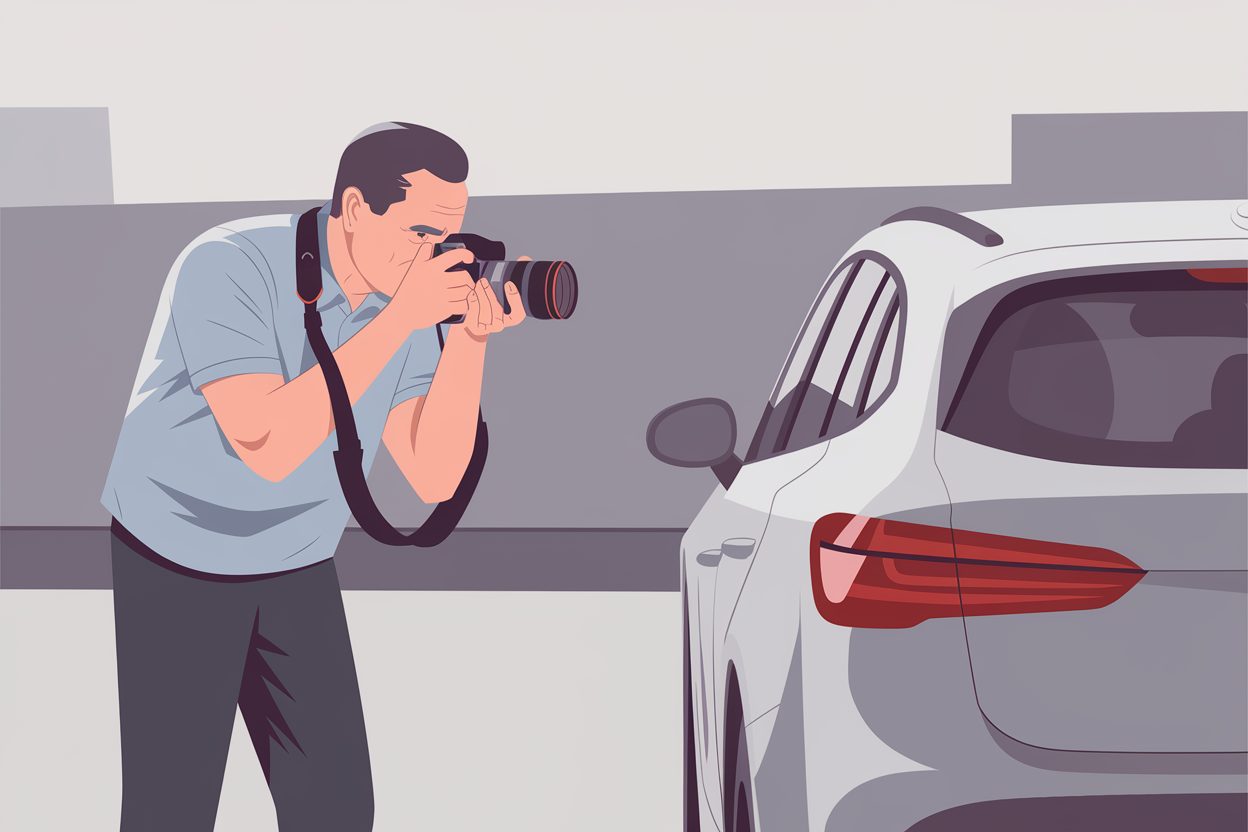

Matt Murray wants to know if he should still take pictures of his rental car before he drives it off the lot. The answer is complicated.
The question came up when he rented an Audi A4 in Tampa recently.
“The car rental company had at least four cameras recording as the car left the gate,” remembers Murray, a real estate agent from Westport, Conn.
He told the attendant he preferred to take his own photos to document any possible damage, but an attendant assured him he didn’t need to. (He took pictures anyway.)
“But that got me thinking,” he says. “Do I still need to take pictures?”
Short answer: Yes, you do. And there’s a reason for it.
Why people take pictures of their rental car
Travelers take snapshots of their rental car for all kinds of reasons — to document their vacation, or to show off a hot set of wheels to their friends. But the biggest one is to show the condition of the vehicle before and after they rent it. They do it because they don’t want to get charged for damage to the vehicle that didn’t happen during their rental.
Before smartphones, taking images of a rental wasn’t always possible because you needed to travel with a camera. Now, many travelers automatically take images just in case there’s a damage claim. The time-stamped and geotagged photos show the car’s condition at pickup and return, which allows the renter to respond to any damage claim by the car rental company.
For years, car rental companies have invited their customers to document the condition of their vehicle, either through an inspection or by taking images. (One company, Turo, even integrated a photo-inspection feature into its app so drivers could take a picture of their vehicle.)
“We actively encourage renters to be engaged in our vehicle inspection process, and we welcome customers taking pictures of their vehicle at time of pickup,” says Mike Wilmering, a spokesman for Enterprise Mobility.
Car rental companies assume that the last person who rents the car before they discover damage is responsible for it. Having photos of the car at drop-off can protect a car rental customer from thousands of dollars in wrong damage claims.
How car rental inspections work
Here’s how car rental inspections have typically worked, according to Wilmering.
At a non-airport location, a team member walks around the car with the renter to review the condition of the vehicle and ensure everything is appropriately captured on the rental agreement.
At Enterprise’s airport locations, where renters are typically in a hurry, the company conducts an inspection in advance, and the customer then receives a report on the condition of the vehicle on their rental agreement.
Wilmering says Enterprise is looking into imaging technology but hasn’t implemented it yet.
“We’re exploring all options to ensure the most consistent and best customer experience,” he adds.
But what would that mean?
New vehicle imaging technology could eliminate the need for manual car rental photos
Vehicle imaging technology that photographs rental cars has been around for decades. But new products from companies such as Damage iD, InspektLabs, and DeGould use artificial intelligence to identify damage to a rental vehicle.
The process is simple. A rental agent takes pictures of the vehicle’s exterior from different angles using a smartphone app. When you return the car, the agent repeats the process. These apps also zoom in to take close-ups of potential damage. An AI bot compares both sets of before-and-after photos side-by-side to identify any new damage. Then it stores the pictures in the cloud. The technology is most likely to be used by independent or franchise car rental locations.
Many large rental companies also use automated imaging systems that employ drive-through cameras to snap pictures of the entire car, front and back, before and after the rental. Major car rental companies are testing or implementing the technology, according to industry experts.
“The technology can save rental companies money and a headache in terms of conflicts with renters,” says Fran Majidi, an insurance expert at SmartFinancial, an insurance-comparison website.
Vehicle imaging technology is becoming more popular. Automated imaging systems will be rolled out to about 100 large airport locations in the U.S. by the end of this month, according to Mark Mannell, CEO of CarRentalSavers.com.
“But it’s too early to tell if this will be beneficial to renters — or just a source of revenue for rental agencies,” he adds.
What are the benefits of vehicle imaging technology?
The latest imaging technology promises to address one of the most contentious issues in the car rental industry. When a car rental company finds damage to one of its cars, it bills the last renter for the damage. The charge can also include a service fee for the damage recovery and a fee for loss of use. Car rental companies don’t always get it right.
“Sadly, there are still car rental companies that may operate unscrupulously and charge unwitting customers for damage that was pre-existing,” says Alex Villalobos, director of operations at the Costa Rican car rental company Vamos Rent-A-Car.
The technology could end that by providing photographic documentation of the damage, showing the correct renter who returned the damaged vehicle. Car rental companies benefit because they can bill the right renter for the ding or dent. But it can also prove a renter’s innocence when that person is falsely accused of damaging a vehicle.
What are the problems with vehicle imaging technology?
The imaging technology has a few challenges, according to experts.
Image quality. The images generated by the technology are sometimes insufficient to prove a renter is responsible for damage. “There are system limitations like the quality of the images and angle coverage that can mean that not all damage can be properly captured,” says Deege Carse, a director of Trackershop, a vehicle security company.
Human error. “The technology isn’t foolproof,” says Rob DeLisa, founder of CarLeaseTips.com, He says issues like low lighting, missed angles, or disputed timestamps can still happen, resulting in renters incorrectly being billed for damage.
Overreliance on AI. While imaging technology can often effectively identify anomalies between the start and the end of a rental, it becomes too easy for a car rental company to simply give the entire damage case to AI. That means there are almost no humans reviewing a damage claim to ensure that it makes sense. As a consumer advocate, I’ve run into a few of these “too much AI” damage cases.
As imaging technology becomes more common, many car rental companies have adopted more rigid attitudes toward damage noted on these systems. The attitude is, “The system can’t be wrong.” And that means customers need to keep their own records.
You should still take manual photos of your car rental
“The photos that the associates of the rental places take are for their protection, not yours,” says Don Orkoskey, a commercial photographer and former car rental agent. “They will and do miss damage when checking cars and trucks out, but may not miss them when checking them in.”
Fact is, although the new imaging technology can help, most of the car rental employees have little time to check the cars when they’ve been returned. They can — and often do — miss an angle or a side of the car.
Make sure you get the following pictures on your phone:
- The hood and front bumper, especially the windshield and VIN placard.
- The roof.
- Both side, including each door, rims and tires.
- The back, the bumper and the rear windshield.
- The license plate.
Don’t forget the interior of the vehicle — seats, dashboard, floors. If you see damage, ask for a different car. If there are none, make sure the damage is documented in writing.
“And make sure your photos are time-stamped,” says Maya Afilalo, an industry analyst at AutoInsurance.com. (Most photos taken with a smartphone will be.) “Keep the photos saved after you return the car.”
Car renters like Murray, the real estate agent from Connecticut, can feel a little more confident that car rental companies are documenting the condition of his vehicle. But the agent who suggested he didn’t need to take any photos of his car was wrong.
New imaging technology may protect renters. Or it may give rental companies a license to pursue more of their customers for damage to their vehicles. Now, more than ever, you need to protect yourself.